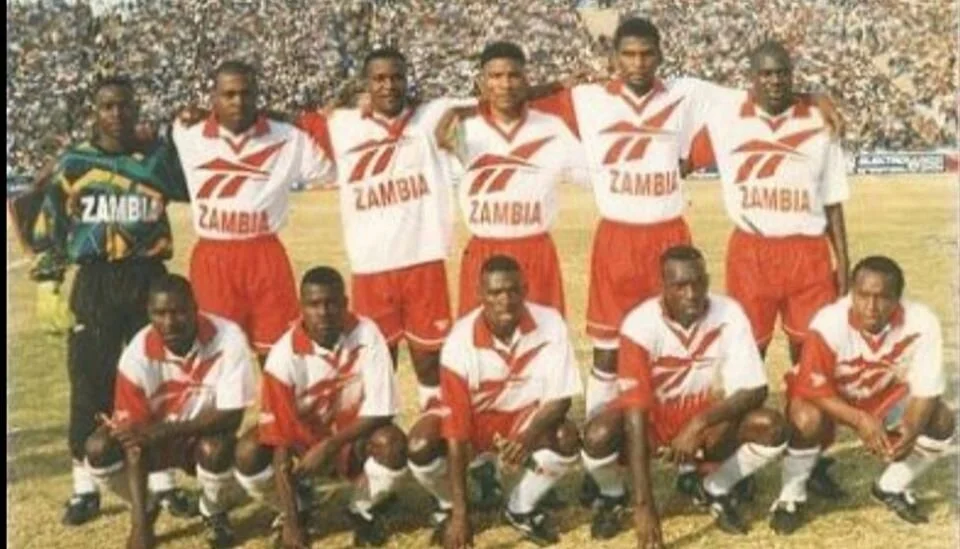
End of An Era by Ponga Liwewe
The 90,000 fans at the FNB Stadium in Johannesburg are delirious with joy. The famous South African song, Sosholoza, rings around the huge bowl as Zambia dejectedly troop off the pitch. The world cup dream is over, ended by the clinical finishing of Helman Mkhelele and Phil Masinga, who score within the first sixteen minutes of the first half. Fourteen minutes before the end, Mark Williams puts Zambia out of her misery with a third goal. For the thousands of fans who have made the trip to Johannesburg, it is a disastrous blow that sees many reduced to tears.
What has gone wrong? A year ago Zambia finished the 1996 Africa Cup of Nations in third place with a 1-0 victory over Ghana's Black Stars. The Zambian team is ranked among the best in Africa and it is a surprise when Tunisia eliminate them in the semi-final when they look set to win the tournament.
After many years of relative success, in the eighties and nineties, when Zambia reach the final of the 1994 Africa Cup of Nations and finish third twice, and Nkana and Power Dynamos consecutively become runner-up and champion in African club competitions, the loss to South Africa shows a team in terminal decline.
This is the first visible sign of cracks in the Zambian armour. In truth, the deterioration has been in effect since the late eighties. On the field, it does not show until almost a decade later. The root of the malaise lies in the declining economic fortunes of the copper mining industry. The mining conglomerate Zambia Consolidated Copper Mines, ZCCM, is losing up to $1million a month as the inefficiencies of state-run enterprises become an albatross around the company's neck.
This leads to reduced spending on sports and, by 1991 when the Kenneth Kaunda-led government falls to the recently-formed Movement for Multiparty Democracy, football is devastated by the apathy of the companies that replace the state-run enterprises. They come with the sole objective of making profits and running sports clubs is considered a drain on the coffers.
First to go are the youth clubs that act as feeders to the main team. These are the clubs that introduce players to their first taste of club football. Below them, schools football, which has been the mainstay of the Zambian game, vanishes as the Ministry of Education desperately seeks to cut costs. The mine-run community center’s cease to exist. Within a couple of years, more than 200 clubs go out of existence as companies are shut down, sold, or operate at a fraction of their previous capacities.
As the eighties-generation of stars begin to wane, it is clear that the players now coming into the team are not cut from the same cloth. By the middle of 1997, the national team is an amalgamation of players from two distinct generations and this hybrid team is unable to reach the height of expectation set in previous years.
In the qualifiers for the 1998 world cup, the warning shots come in the opening match when Zambia lose 1-0 to Congo Brazzaville, and are then held at home to a 0-0 draw by South Africa . The result is all the more disappointing as Zambia, in the last eleven years, have won all but one of their home matches, the only draw coming against Zimbabwe in 1993.
Zambia's next opponent, Zaire, are then forced to play their next match in neutral Zimbabwe because of the rapidly-declining political situation. As troops of the AFDL, led by Laurent Kabila, approach Kinshasa with Mobuto Seseseko embattled, Zambia have a great chance to pick up three points. But they only manage a 2-2 draw, a result which forces coaches Samuel Zoom Ndlovu and Freddie Mwila to resign. Two points from three matches is clearly not good enough.
George Mungwa is brought in to replace the duo and makes an immediate impact when Zambia beat Congo Brazzaville 3-0 in Lusaka. Still, the next match against South Africa is critical as both South Africa and Zaire are above Zambia in the group. Of the team that start against South Africa, however, four players are over thirty and considered past their best. Two quick goals leave Zambia discombobulated. After ninety minutes and a 3-0 humbling, Zambia's world cup dream ends.
The 2-0 win over Zaire in the final match of the group is a case of too little too late and is only a matter of pride between two old rivals. It will take 13 years before Zambia shows any semblance of a revival with a place in the quarter-final in Angola at the 2010 Africa Cup of Nations.
Source: FAZ